Similar program to Memory Cafe (YMCA) Pointillism


See the slides from the presentation
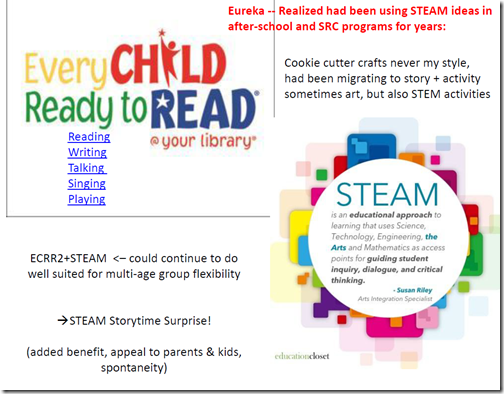
Rebranding storytime as a S.T.E.A.M. Storytime Surprise allows librarians to use the ECRR2 format for early literacy and combine that with the interest and excitement that STEAM brings – not just elements of Science and Technology and Engineering, but also Arts and Mathematics. This format emphasizes process during craft and play times; examples of successful programs for children ages 3-10 years will be shared.
Info from other programs at the presentation is here: https://www.njstatelib.org/services_for_libraries/consulting_services/youth_services/2018-youth-services-forum/
****************************
Previous Workshops for Librarians & Educators:

Slides here: UnCommon Core -- Youth Services Forum 2014 –Slides
Bibliography: “UnCommon-Core” -- Outstanding Informational Read-Alouds for PreSchool & Primary Students

Picture This: Adventures in Art & Imagination
Interested in taking your school-age programing in another direction? Want some ideas for this summer’s Summer Reading Club “Be Creative @ Your Library?” Carol Simon Levin (Somerset County Library - Bridgewater) will share ideas from a program she created that merges literature, art, and creativity. She'll present her program plans for everything from prehistoric cave paintings to Pointillism, Cubism to Chagall, Escher, O'Keefe, Matisse, and many more. It is a program suitable for both public libraries and school settings.
NJLA 2009 “Picture This” Slides and Program Notes
(a revised version of my 2007 Youth Services Forum program)
************************


 Maker Program: Emily Roebling Builds a Bridge–A Hands-On Program for Exploring Bridge Building and Encouraging Women in Engineering
"Emily Roebling" tells the story of her role in the construction of the Brooklyn Bridge then assists children & tweens as they experiment with bridge designs & construction.
Carol Simon Levin portraying “Emily Warren Roebling”
Artist Day Program Table signs for this program can be found here.

There will be a variety of activities available for children aged 3 and up including:
Families can arrive and leave at any time. Parents and/or caregivers are expected to stay with children during their museum visit.
Note: More detailed plans for single programs on each of these artists can be found in other blog entries hot-linked to the titles below. Also done as Play With Art.
General Books & Materials:
CD player
CDs:
Books: (a sampling)
Videos:
WELCOME -- COME EXPLORE ARTISTS TODAY
EACH STATION FEATURES A DIFFERENT ARTIST OR STYLE
To get the most out of this program, we recommend that you read (or browse) the book(s) before using the materials to create your own artwork in their styles.
There is no “right way” to do art and we have only 2 rules:
1. Please clean up when you have finished a project.
2. HAVE FUN!
The First Artists 30,000 Years Ago!
BOOKS TO SHARE:
MATERIALS TO USE TO MAKE OUR CAVE ART MURAL:
Paleolithic art the oldest known (ca. 30,000 years old) examples of which were discovered in 1994 at the Chauvet Grotto in southeastern France. Other famous sites that yielded more recent works are: Cosquer, France (19,000-27,000 years old), Altamira, Spain (14,000-16,000 years old) and Lascaux, France (10,000-15,000 years old). This type of art predominately features paintings of animals.


"What can you do with a line?"
Squiggle pictures to get those creative juices flowing.
START WITH A SQUIGGLE AND SEE WHAT IT TURNS OUT TO BE!
BOOKS TO SHARE:
MATERIALS TO USE:
One person (parent or child) draws a squiggle; the other completes the drawing to make a picture!

"What can you do with a dot?" Pointillism in the style of Seurat.
Sunday Afternoon on the Island of La Grande Jatte shows people of all different classes in a park. The tiny juxtaposed dots of multi- colored paint allow the eye of the viewer to blend colors optically, rather than having the colors blended on the canvas or pre-blended as a material pigment. It took Seurat two years to complete this ten foot wide painting, and he spent much time in the park sketching to prepare for the work. It is now exhibited in the permanent collection of the Art Institute of Chicago.
BOOKS TO SHARE:
MATERIALS TO USE:
Create a picture using Q-Tips to paint dots on your paper. Notice how your eyes blend the dots into other colors when you step back from your picture.
"What Can You Do with a Dab?" Watercolor Painting in the Style of Monet
BOOKS TO SHARE:
MATERIALS TO USE:
Try dabbing watercolor paint on paper to make your own impressionist painting.

Impressionism was a 19th century art movement that began as a loose association of Paris-based artists, who began exhibiting their art publicly in the 1860s. The name of the movement is derived from the title of a Claude Monet work, Impression, Sunrise (Impression, soleil levant.
Characteristics of Impressionist painting include visible brushstrokes, light colors, open composition, emphasis on light in its changing qualities (often accentuating the effects of the passage of time), ordinary subject matter, and unusual visual angles.
They used short, "broken" brush strokes of pure and unmixed color, not smoothly blended, as was the custom at the time. For example, instead of physically mixing yellow and blue paint, they placed unmixed yellow paint on the canvas next to unmixed blue paint, so that the colors would mingle in the eye of the viewer to create the "impression" of green. Painting realistic scenes of modern life, they emphasized vivid overall effects rather than details.
"Drawing with Scissors" Cut-up collages a la Matisse.
BOOKS TO SHARE:
MATERIALS TO USE:
Create a cut-out collage with bold shapes and colors.
What can you do with a face (or a body?)
Rearrange it in the style of Picasso!
Things to try – Draw a self-portrait, then cut it up and rearrange the pieces!
"Mixed-up Faces"
Portraits in the Style of Picasso.
 Cubism

An early 20th-century school of painting and sculpture that was created principally by the painters Pablo Picasso and Georges Braque in which the subject matter is portrayed by geometric forms without realistic detail, stressing abstract form at the expense of other pictorial elements largely by use of intersecting often transparent cubes and cones. The Cubist style emphasized the flat, two-dimensional surface of the picture plane. Cubist painters were not bound to copying form, texture, color, and space; instead, they presented a new reality in paintings that depicted radically fragmented objects, whose several sides were seen simultaneously.
BOOKS TO SHARE:
MATERIALS TO USE:
· Gluesticks
Create a mixed-up picture of a person (or make a regular picture and then cut it up and rearrange the pieces)!
"Picturing the Impossible"
The Surreal Images of Magritte & Dali.
BOOKS TO SHARE:
MATERIALS TO USE:
Create your own Surrealist images by juxtaposing different pictures from magazines.
"Dreamer from a Village"
The Amazing Visions of Marc Chagall.
BOOKS TO SHARE:
MATERIALS TO USE:
Create your own dream-inspired images through either painting or pasting multimedia collage materials.
"What Can You Do with a Shape?" The Vibrant Images of Wassily Kandinsky
BOOKS TO SHARE:
MATERIALS TO USE:
Experiment with shape, line, balance, and color to create a Kandinsky-inspired image.
Next time – Michaelangelo Sistine chapel under card table
http://www.mcs.csuhayward.edu/~malek/Java/Magritte.html
Info. About grounds for sculpture
Check out more ideas at: http://carolsimonlevin.blogspot.com/search/label/Picture%20This