Wednesday, March 12, 2014

Picture This: April Fools! Yellow Cows, Green People, Red Trees, and Blue Horses: The surprising art of Wassily Kandisky, Paul Klee, and their friends.


Picture This: April Fools!   Yellow Cows, Green People, Red Trees, and Blue Horses: The surprising art of Wassily Kandisky, Paul Klee, and their friends. (Grades K-5)

“Come hear the story of these expressionist painters and create your own brilliantly-colored paintings.”

·         Read aloud:  The Blue Rider: The Yellow Cow Sees the World in Blue (Adventures in Art Series)  (J759.0642 KUT)  (Kandinsky, Klee, Alexej Jawlensky, August Macke, Franz Marc and Gabrielle Munter) and/or The Noisy Paint Box*  by Barb Rosenstock (JB Kandinsky) (Mentions Kandinsky's synesthesia)

<!--[if !supportLists]-->·         <!--[endif]-->Showed:  Wassily Kandinsky (J759.7 FLU)  and  Paul Klee (J759.91 VEN)  (both Getting to Know the World’s Greatest Artists)  Paul Klee (J759.91 RAB), Paul Klee (J759.91 CON)

<!--[if !supportLists]-->·         <!--[endif]-->Made tempera paintings – expressionistic designs with vibrant colors, -- Usborne Art Treasury J750.11 DIC p/52-55 Kandinsky – Squares with Colored Circles – Color Contrasts,

·         Other ideas: Start with Art: People (J704.942 LAC) p. 12 pattern and color, p22 abstract portraits, Magical Fish Klee – The Golden Fish  Usborne Art Treasury J750.11 DIC p/28-31, The Art Book for Children v.2 (J709 REN) “Music to My Eyes” – Kandinsky p.46-47  http://thechocolatemuffintree.blogspot.com/2014/03/how-to-make-abstract-kandinsky-painting.html
 
4.08
*more ideas  from: http://www.slj.com/2014/03/collection-development/jlg-booktalks/stellar-nonfiction-for-young-readers/:

4.15:
Open with this showing:  Kandinsky moody music: https://www.youtube.com/watch?v=o5wqlj2nmcs
Then read:
Noisy Paintbox Stellar Nonfiction for Young Readers│ JLG’s Booktalks to GoROSENSTOCK, Barb. The Noisy Paint Box: The Colors and Sounds of Kandinsky’s Abstract Art. illus. by Mary Grandpré.Knopf. 2014. ISBN 9780307978493. JLG Level:  E+ : Easy Reading (Grades 1–3).
Vasya Kandinsky’s proper life would never be the same after his aunt gave him his first paint supplies. The colors seemed to whisper to him―what a noisy paint box! He worked until the colors went quiet. But no one understood what his paintings said, so he began to paint like everyone else. It would take a trip to the opera for the artist to unleash the power of his work. And he would never paint “properly” again.
Resources abound for this beautifully written and illustrated work. A Pinterest board features Kandinsky lessons. The Classroom Bookshelf published a post of the new title with resources for teaching. Watch a book trailer on Rosenstock’s website. You can invite the author to your school, visit via Skype, or follow her on Twitter or Pinterest. Harry Potter fans will recognize Mary Grandpré’s artwork and may want to visit her website. Perhaps you can’t take a field trip to the New York City art museum, but your students can view the Kandinsky Guggenheim exhibit online. http://www.livebinders.com/play/play/1198808

Briefly discussed synesthesia and showed pictures of some of his abstract paintings.  Then put on album "Jazz Playground" (Putamayo international music) and had kids use tempera paints to "paint what the music sounded like." (multicultural album provides lots of variety)  (Supplies: large paper, paint, brushes, water cups)


Saturday, March 8, 2014

Picture This: "Play With Art"


“Play with Art” (Ages 3-10)


What can you do with a dot, a line, a shape, a pair of scissors, a dab of paint and your imagination?  Anything you want!  Come “Be Creative @ Your Library” and “Play with Art” as we kick off a summer of creative fun at the library.

This is a program which incorporated many of the materials prepared for other programs in the "Picture This" series.  
(Detailed descriptions of each project can be found in those other program plans.  Different stations based on some of the programs we’ve held -- stations with self-directed instruction sheets – contact me if you want these.)


Read “Bear’s Picture” – Pinkwater and/or “The Dot”  - Reynolds

Stations:
·         "What can you do with a line?" -- Squiggle pictures to get those creative juices flowing. (inspired by the book: Harold & the Purple Crayon)
·         "What can you do with a dot?" -- Pointillism with Q-tips in the style of Seurat.
·         "What can you do with a dab?" -- Watercolor painting in the style of Monet.
·         "What can you do with a pair of Scissors?" -- Cut-up collages in the style of Matisse or mixed-up faces a la Picasso.
·         "What can you do with some magazine pictures? -- Picturing the impossible -- Surreal pictures a la Magritte & Dali.
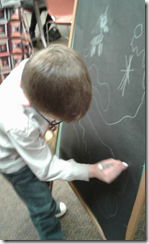
·         “What can you do with a wall & chalk?” --Cave Painting in the style of the first artists 32,000 years ago.

·         “What can you do with your imagination?” – anything you want!

Picture This: Art Exploration For Kids: Gods in Color – New views of the Art of Ancient Greece


Picture This: Art Exploration For Kids: Gods in Color – New views of the Art of Ancient Greece


(Program for Kdg-5th graders)
 
“Travel back in time with us to Ancient Greece, meet the Gods from Mount Olympus, and hear about a surprising discovery scientists recently made about the sculptures there – then create a statue of your own! “
PowerPointpresentation available.


  • Display books: Rick Riordan (Lightning Thief ) , Joan Holub (Goddess Girls), Carolyn Hennesy (Pandora), Greek Mythology (292.13), Ancient Greece (938), Ancient Greek art (709.38)

  • Open by reading Mount Olympus Baskeball by Kevin O'Malley  -- surprise! never thought of basketball and Greek Gods together!!

  • Ask what they know about Greek mythology --  Have they seen statues from Ancient Greece?  What do they look like?
·        Mention even grown-ups surprised sometimes  – I went to an art museum in Boston and discovered that Ancient Greek statues weren’t the white marble I’d always thought!  Research is ahead of most books – most of our Ancient Greek Art books don't show what scientists now know (Ancient Greek Art -- 709.38 Hodge, c2006 mentions it on some of the pages but has no pictures of the reconstructions, nor do any other books to my knowledge!)  Internet sights with pictures & information: http://harvardmagazine.com/2007/11/dazzlers-html

·       Powerpoint presentation featuring pictures from the “Gods in Color” exhibition.  Talk about how scientists discovered remnants of ancient pigments.

·       Craft: Have kids make Greek sculptures out of playdough (since we didn't have time to make sculpture one day and paint or color it the next, we used colored dough -- available very inexpensively at dollar stores).  Some kids sculpted free-form 3D statues, others made a freeze on a cereal box type cardboard base.  Others used the photocopied line drawings of Greek Statues (from the Museum's Family Guide) as a base and used flattened playdough to add pattern & color.  (If you have a multi-day program, you could have them sculpt one day and then paint or color the next day. -- Crayola Model Magic is one possibility for this.)

Music during craft (and while kids arriving): Mosaic: the Music of Greece (Nick Stoubis)

·         Additional resources:  http://christogenea.org/resources/Harvard%20gods%20in%20color%20gallery%20guide.pdf, coloring sheets & handouts from the kid’s guide to the exhibition (not available online unfortunately), books of Ancient Greek sculpture.


Painting of sculpture-- from Wikipedia

By the early 19th century, the systematic excavation of ancient Greek sites had brought forth a plethora of sculptures with traces of notably multicolored surfaces, some of which were still visible. Despite this, influential art historians such as Johann Joachim Winckelmann so strongly opposed the idea of painted Greek sculpture that proponents of painted statues were dismissed as eccentrics, and their views were largely dismissed for more than a century.
It was not until published findings by German archaeologist Vinzenz Brinkmann in the late 20th and early 21st century that the painting of ancient Greek sculptures became an established fact. Using high-intensity lamps, ultraviolet light, specially designed cameras, plaster casts, and certain powdered minerals, Brinkmann proved that the entire Parthenon, including the actual structure as well as the statues, had been painted. He analyzed the pigments of the original paint to discover their composition.
Brinkmann made several painted replicas of Greek statues that went on tour around the world. Also in the collection were replicas of other works of Greek and Roman sculpture, and he demonstrated that the practice of painting sculpture was the norm rather than the exception in Greek and Roman art.[4]Museums that hosted the exhibit included the Glyptotek Museum in Munich, the Vatican Museum, and the National Archaeological Museum in Athens, et al. The collection made its American debut at Harvard University in the Fall of 2007.[5]
 

9/08, 9/11, 10/14

Picture This: Keith Haring: Characters at Play


imageimage
Picture This:  Keith Haring: Characters at Play  (For grades Kdg – 5, plus younger siblings)
Join us as we explore the quirky characters and enthusiastic energy
of this graffiti-inspired artist, then help us make a mural
and create some stand-up sculptures in his signature style.

 
Program:
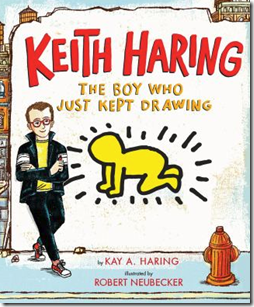
·    Read: Keith Haring: The Boy Who Just Kept Drawing by Kay Haring  (stopped partway through to have kids play the same game Keith played with his father – taking turns adding lines to each other’s drawing.) and/or Art is Life: The Life of Artist Keith Haring by Tami Lewis Brown c2020
 
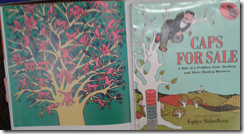
·     Read selections from:  Keith Haring : I wish I didn't have to sleep! Haring, Keith. New York : Prestel, c1997. and board books (if available) Big Haring, Keith.  New York, N.Y. : Hyperion Books for Children, c1998.  10 Haring, Keith.  New York : Hyperion Books for Children, c1998. Text to text connection: Keith’s monkey tree with Esphyr Slobodkina’s Caps for Sale. 
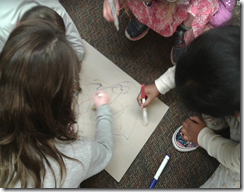
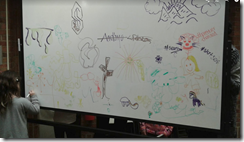
·    Create: Mural & individual pictures & sculptures (out of construction paper). Materials for mural: bulletin board paper hung on stage, markers, also black paper & white crayons. For individual projects construction paper, scissors, markers, glue sticks, tape.  Also whiteboard with markers (graffiti!)
image
image
   image

imageimageimageimageimageimageimageimageimageimageimageimageimageimageimageimageimageimageimageimageimageimageimage
11/7 4:30 STEAM BWL

Another cool Keith Haring art idea:

image

Keith Haring-Style Foil Squares: Cover pieces of cardboard with smooth aluminum foil before the program. Have children use colored Sharpies to draw men, dots, and lines on the squares. (site also has great ideas for Michelangelo’s Sistine Chapel (art under the table), Roy Lichtenstein-Style Comic Art, Vincent Van Gogh-Style Landscapes with shaving cream, and Dale Chihuly-Style Chandeliers with cut plastic bottles!  https://www.alsc.ala.org/blog/2018/01/painting-table-innovative-k-5-art-programs/

Explore Art! Find more about Keith Haring at this website: http://www.haringkids.com/
Keith Haring : I wish I didn't have to sleep! (J709.2 HAR) (and all the books in the Adventures in Art series – ask a librarian to help you find them.) 
image
Other good books  to introduce art and encourage creativity:

The Dot and Ish – Peter Reynolds
Seen Art?  -- John Scieszka and Lane Smith
Art -- Patrick McDonnell
The Turn About, Think About, Look About Book -- Beau Gardner
Micawber – John Lithgow
Eggs Mark the Spot – Mary Jane Auch
I Ain’t Gonna Paint No More! – Karen Beaumont
Jack in Search of Art – Arlene Boehm
Anna’s Art Adventure – Bjorn Sortland
Applemondo’s Dreams – Patricia Polacco
Drawing Lessons from a Bear – David McPhail
The Gentleman & the Kitchen Maid – Diane Stanley
All I See – Cynthia Rylant
More than Meets the Eye: Seeing Art With All Five Senses (J759 RAC)
The Shape Game (J708 BRO)
Hidden Pictures (J701 BOL)
Squeaking of Art (J701.1 WEL)
Great Art Adventure (J701.1 KNO)
Dan’s Angel – A Detective’s Guide to the Language of Paintings (J750.11 STU)
Fold Me a Poem (811.54 GEO) 
Stories in Art (701.1 WIL)
Discover Great Paintings (J701.1 MIC)

Also check out these art books by Joyce Raimondo: What's the big idea? : activities and adventures in abstract art, Make it pop! : activities and adventures in Pop art , Express yourself! : activities and adventures in expressionism , Imagine that! : activities and adventures in Surrealism , Picture this! : activities and adventures in Impressionism 
 
DVDs:


Behind the Scenes
This series hosted by Penn & Teller provides clever and engaging profiles of David Hockney, Julie Taymor, Wayne Thiebaud, Matt Groening, David Parsons, JoAnn Falletta, Robert Gil de Montes, Carrie Mae Weems, William Wegman, Allen Toussaint, Bobby McFerrin, Nancy Graves, and Max Roach.  Great segments to share on color, perspective, etc.
 
Getting to Know (series)  Da Vinci    Michelangelo   Monet    Van Gogh    Rembrandt     Andy Warhol 
Humorous very accessible overviews based on the books by Mike Venezia.  An alternative way of introducing artists.
 
Dropping in on…(series)     Andy Warhol   Grant Wood   Matisse   Picasso  Romare Bearden    Rousseau
Puffer the bird interviews various artists and asks questions about their works in these simply animated programs. 
 
Who is the Artist?   Viewers learn to identify the styles of different artists within a movement by comparing & contrasting their styles.


Picture This: Art & Geometry: Celebrating “The Perfect Square”

 
Art & Geometry: Celebrating “The Perfect Square”
Kdg-5th grade program done inside the library and as an afterschool outreach
 
A square always has 4 equal sides and 4 equal angles, but with a bit of imagination, it can become anything!   We shared books on art and creativity, made pictures by cutting up a square and also explored  the square with origami, tangrams, and mathematical puzzles.   Here is a list of some of the items we showed and shared in case you want to check them out from the library.  (All are in the Picture Book Section under their author’s last name unless they have a Dewey Decimal Number listed.)
 
Read: Perfect Square – Hall plus a selection of other  books celebrating art, creativity, and different ways of looking at things:
Bear’s Picture – D.B. Johnson
Elephants Can Paint Too (599.67 ARN) – non-fiction (check out the elephant-created floral paintings – they’re amazing!)
Dot – Peter Reynolds (also his Ish)
Changes– Anthony Browne
I Ain’t a-Gonna Paint No More – Karen Beaumont
  • Math Riddles from Math Appeal and Math for All Seasons -- Greg Tang
 
  • Our activity stations included:
 
    • Create Your Own “Perfect Square” – cut up a square and reassemble (artwork inspired by our featured book Perfect Square by Michael Hall (tissue paper squares, 8x11 paper to mount on, scissors, gluesticks, hole punches)
    • Math puzzles -- pages photocopied from Shape Shuffle 793.73 WOR (toothpicks, buttons), additional math puzzle books of Greg Tang (mentioned above), The Everything  Kids’ Math Puzzles Book (510 CLE), Let’s Investigate Shape Patterns (516.15  SMO), Growing Patterns: Fibonacci Numbers in Nature (512.72 CAM)  (toothpicks or craftsticks, buttons or coins), Shape and Pattern (516 CLE), Math Fun with Tricky Lines and Shapes (793.74 WYL)
    • Tangrams printouts from http://www.activityvillage.co.uk/tangram_puzzles.htm
    • Origami (lots of titles in 745.54), kids might also enjoy Fold Me a Poem (811.54 GEO) (origami YODA http://origamiyoda.wordpress.com/folding-your-own-origami-yoda-other-star-wars-papercraft/)
    • Books on Optical Illusions and Changing Pictures – books including Geometric Optical Illusions (152.148 SEC), Imagine a Night – Rob Gonsalves, Imagine a Day – Rob Gonsalves, Imagine a Time – Rob Gonsalves, Duck! Rabbit! – Amy Krouse Rosenthal, Palazzo Inverso – D.B. Johnson, Here a Face, There a Face – Arlene Alda
    • Additional Art & Creativity books: Look! Look! Look! – Nancy Wallace, What’s the Big Idea? Activities & Adventures in Abstract Art (709.04 RAI), How Artists Use Shape (701.8 FLU), I Spy Shapes  in Art – Mickelthwait, The Dot and the Line – Norton Juster, Dinner at Magritte’s – Michael Garland, What is this? – Antje Damm, How are you Peeling – Saxton Freymann
5/12

image

Related Posts Plugin for WordPress, Blogger...