Showing posts with label Mathematics. Show all posts

Tuesday, October 30, 2018

STEAM Storytime Surprise -- Youth Services Forum Oct. 29, 2018 Presentation

image

image
See the slides from the presentation
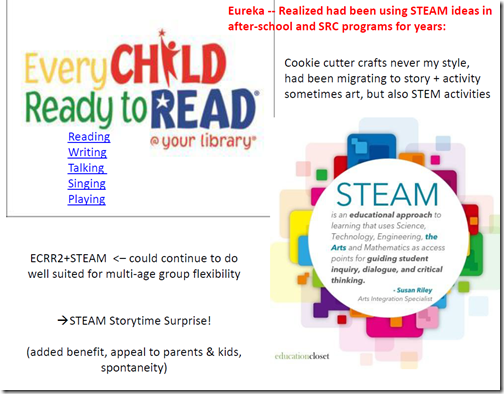
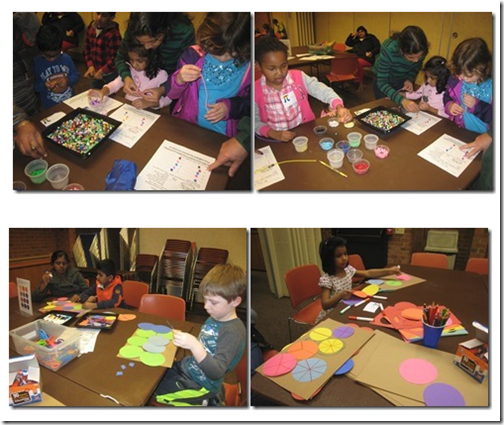
Rebranding storytime as a S.T.E.A.M. Storytime Surprise allows librarians to use the ECRR2 format for early literacy and combine that with the interest and excitement that STEAM brings – not just elements of Science and Technology and Engineering, but also Arts and Mathematics. This format emphasizes process during craft and play times; examples of successful programs for children ages 3-10 years will be shared. 

Info from other programs at the presentation is here: https://www.njstatelib.org/services_for_libraries/consulting_services/youth_services/2018-youth-services-forum/

****************************

Previous Workshops for Librarians & Educators:

imageSlides & Resources at: Storytime Shake Up -- Jazzing Up Storytime Programs


image

Slides: Books Alive! Storytelling Workshop

Around the year thematic bibliography: Using Storytelling Skills and Interactive Books to Create Excitement and Empathy in Your Students 


imageimage
Slides here: UnCommon Core -- Youth Services Forum 2014 –Slides

Bibliography:  “UnCommon-Core” -- Outstanding Informational Read-Alouds for PreSchool & Primary Students


image

Picture This: Adventures in Art & Imagination
Interested in taking your school-age programing in another direction? Want some ideas for this summer’s Summer Reading Club “Be Creative @ Your Library?” Carol Simon Levin (Somerset County Library - Bridgewater) will share ideas from a program she created that merges literature, art, and creativity. She'll present her program plans for everything from prehistoric cave paintings to Pointillism, Cubism to Chagall, Escher, O'Keefe, Matisse, and many more. It is a program suitable for both public libraries and school settings.

NJLA 2009 “Picture This” Slides and  Program Notes 
(a revised version of my 2007 Youth Services Forum program)

************************


imageCarol Simon Levin is a retired youth services librarian, author, storyteller and program presenter for audiences of all ages based in Somerset County, NJ. Whether she is impersonating the woman who helped to build the Brooklyn Bridge, engaging families in a rousing Halloween Hootenanny of songs and stories, expanding on the mathematical and artistic possibilities of a simple square, or sharing the story of a dolphin who learned to swim with an artificial tail (along with activities to help children understand what it is like to live with a disability), Carol always strives to create exciting programs that engage her audience’s interests and expand their horizons.  Librarians are welcome to replicate or use portions of any of these programs. If you have questions or need more details (including providing song tunes), contact her at cslevin59 (at) gmail.com or 908-361-6519.

bring the stories 6

Maker Program: Emily Roebling Builds a Bridge–A Hands-On Program for Exploring Bridge Building and Encouraging Women in Engineering

"Emily Roebling" tells the story of her role in the construction of the Brooklyn Bridge then assists children & tweens as they experiment with bridge designs & construction.


Carol Simon Levin portraying “Emily Warren Roebling”

Monday, March 14, 2016

Pi Day!

All ages challenge – stop by the library on March 14th and recite Pi to the farthest number you can memorize.  We’ll keep score and give you a medal for trying!

Celebrate International Pi Day with  stories,  mathematical art and fun! Everyone from Preschoolers to Pre-teens will have lots of fun things to do. 

Playing as kids arrive Pi Song from http://www.whatdowedoallday.com/2016/02/pi-day-activities.html, other Pi videos follow.

As kids arrive, encourage them to work together and browse through displayed books -- recreational math books from 793.74, Bedtime Math books 513.2 OVE and other fun 510s, Greg Tang’s Grapes of Math series (Picture Book TANG), Sir Circumferance series (Picture Book NEWSHWANDER), Stuart Murphy’s math books (Picture Book MURPHY) etc.

Had them try Pie math: title poem from Edgar Allen’s Poe’s Pie: Math Puzzlers in Classic Poems (811.54 LEW) (let them use paper plates and pipe cleaners to figure out), pizza problem from Greg Tang’s The Grapes of Math.

Read Sir Cumference and the Dragon of Pi: A Math Adventure (Picture Book NEWSHWANDER) – stop on the page with the pie and hand out various-sized circles along with scissors & a pipe cleaner – have kids measure the circle with the pipe cleaner then cut off the excess and fold the pipe cleaner across the diameter…all should find that the pipe cleaner goes across 3 times with a little left over. Inspired by: http://sparklingbuds.com/2014/03/introduction-to-pi-a-simple-activity-for-pi-day.html  Resume the story.  The story ends with the decimal 3.14159 about 1/7. 

(omitted this) Have the kids stand in a circle holding hands.  Wrap string around the circle, then weave it back and forth to show our 3 and a bit left over number again.

Mention that Pi is a very unusual number…goes on forever and ever.  (Show picture of Pi with many digits http://www.whatdowedoallday.com/wp-content/uploads/2016/02/%CF%80.pdf). 

Placed the numbers 0-10 on the rug around the room and had kids move around as I recited the digits of Pi so they could realize there was no pattern. (kids loved this!)

More Pi play (stations for different ages – since this was an all ages program):

Lego/Duplo Pi Skyline counting activity: http://www.homegrownlearners.com/home/2014/3/19/learn-about-pi-with-lego-bricks-free-printable.html

image

Pi Day graph skyline: http://www.whatdowedoallday.com/2014/03/math-art-for-kids-pi.html

 image

Color the number of squares on the graph representing each digit of Pi. Then cut out your “skyline” and mount it on colored paper.

Pi Day Bracelets (great pattern activity –very popular station)  http://www.pinkstripeysocks.com/2014/03/pi-day-activity-make-pi-day-bracelets.html  free planning worksheet: www.teacherspayteachers.com/FreeDownload/Pi-Day-Bracelets

image

image

Color a Pi poster: http://teachingisagift.blogspot.ca/2013/03/huge-pi-day-celebration-and-freebies.html

Circle Art & Experimentation (Pi/Pie Math) – Make free-form pictures with different-sized circles (Ellison die cut), Cut some in half/quarters/eighths/thirds/fifths/sevenths to add “pieces of pie” to the pictures -- playing with fractions.

image

https://www.psdblogs.ca/jpodhaniuk/files/2014/10/fractions-circles-2gh0nkq.jpg

Also had a table with math games & challenges left over from our Leap Day program:
http://carolsimonlevin.blogspot.com/search/label/Leap%20Year – older kids really enjoyed doing these.

Other possibilities here: www.whatdowedoallday.com/2016/02/pi-day-activities.html

Other cool math videos: http://www.whatdowedoallday.com/2014/08/math-youtube-channels.html

image

 
3.16 BWL

image

Tuesday, March 8, 2016

Make Math Fun–Suggestions from whatdowedoallday.com


Want to make your kids more math savvy every day of the year?   Check out these booklists & activity suggestions courtesy of whatdowedoallday.com:

10 MATH BOOKS FOR BABIES AND TODDLERS

image

www.whatdowedoallday.com/2015/01/math-books-for-babies-and-toddlers.html  The toddler set is focusing on pattern learning, relative sizes and pairing. Their attention span for lap-sitting and reading is also very short. Focus on books with engaging, happy and simple text and bold, pattern-oriented illustrations. Just remember, your baby and toddler does not need how to learn to add and subtract!  More ideas 10 ways to make math fun for babies and toddlers!


MATH BOOKS FOR PRESCHOOLERS

imagewww.whatdowedoallday.com/2015/02/math-books-preschoolers.html In no way is there a dearth of counting, shape and pattern books for preschoolers. This book list is a great way to start, but is by no means exhaustive! Once you start looking at the library you will easily find many more to add to your reading list. For more on easy and fun hands-on activities to encourage your young children to love math, read 7 Simple Math Activities for Preschool at The Measured Mom.


MATH PICTURE BOOKS (KINDERGARTEN, 1ST AND 2ND GRADES)

imagewww.whatdowedoallday.com/2015/02/math-picture-books.html -- math books that incorporate concepts into engaging stories, or books that challenge kids to see math in the natural world around them rather than “math teaching books.” More age appropriate math activities from The Measured Mom that will help your kids develop a love of math from the get-go! 


11 ADVANCED CONCEPT MATH PICTURE BOOKS


imagewww.whatdowedoallday.com/2015/03/advanced-concept-math-picture-books.html  These math picture books look at a wide variety of more advanced concepts, from fractals to factorials. They are good for the upper elementary grades and even up to age 12.  And here are some more ideas on how to make math fun for 8 to 12 year olds.


FIBONACCI BOOKS FOR KIDS

image

www.whatdowedoallday.com/2012/02/fibonacci-books-for-kids.html 

Add math to your nature walks – see  if their patterns in flowers, leaves, pine cones etc. adhere to the sequence and try out an open-ended Fibonacci art project!

MATH CHAPTER BOOKS AND STORY COLLECTIONS

  image

Math chapter books and story collections where mathematical concepts play a crucial part of the story. They are excellent tools for cross-curriculum learning. Best of all, even if your child’s favorite subject in school is art or drama or history, all of the books make math accessible and tell a good story. (And by the way, if your kid loves art, try one of these amazing math art projects for kids.) 


8 MATH REFERENCE BOOKS FOR KIDS

image

More great ideas: https://www.whatdowedoallday.com/math-art-books

image

whatdowedoallday.com also offers more than 200 other great booklists on myriad topics!

Looking for a fun way to make math part of your family’s daily activities?  bedtimemath.org offers fun and interesting daily math problems -- 5 quick minutes of number fun for kids and parents at home. Read a cool fun fact, followed by math riddles at different levels so everyone can jump in. Here’s an example:


SHOOTING-STAR SKYDIVERS

Skydiving is one of the craziest sports out there. You jump out of a plane thousands of feet up in the sky, fall at over 100 miles an hour, then pull your “parachute” to slow you down to land. But if LOTS of skydivers jump at once, they can grab each other’s arms to link up and make pictures in the sky. These 164 skydivers hold the world record for the biggest crowd dive, jumping out of 7 planes over Chicago. If you watchthe video, you see how they steered themselves to fall faster or slower to meet each other in the sky. Some fell as fast as 175 miles an hour! They planned out the design down on the ground, then figured out who should grab whom…after all, some divers have a stronger right or left hand, and some dive faster than others. Their totally awesome star shape broke the record of 100 group divers — and everyone’s parachute worked!

Wee ones: How many points does the skydiver star shape have? Remember where you started counting!

Little kids: If 4 people grab hands, and they need 6 in total to make a loop, how many more divers need to join them?  Bonus: The group’s very first dive had just 18 people. If you had gotten to be one of them, how many skydivers would have jumped with you?

Big kids: The old record had 100 people jump in a square. How many more divers did this group have? Bonus: If 12 of the 164 had made a center circle, and the rest of the divers had fanned out to make 8 equal chains, how many divers would have made each chain? (Hint if needed: 8 is 2 x 2 x 2, so to divide by 8, just cut in half 3 times in a row!)

Click HERE for the answers.

Monday, February 29, 2016

Leap Day–Math Play!

Leap Day! Math Play! (Ages 4-12)

Join us as we celebrate this once-every-four-year occasion with some truly wild and wacky mathematics!  We’ll have challenging problems, math riddles, special puzzles, and more for pre-schoolers and pre-teens – and everyone in between! (Caregivers can get into the action too.)  

While kids were arriving let them browse and share math books I’d displayed – lots of recreational math books from the 510s and puzzle books from the 793.73s, plus math picture books like Math Curse by Jon Sciezka,  The Grapes of Math series by Greg Tang, Mathstart series Stuart Murphy and the fun fiction title The Number Devil by Hans Magnus Enzensberger.  More ideas : http://www.whatdowedoallday.com/2014/03/math-reference-books-for-kids.html   http://www.whatdowedoallday.com/2013/03/math-chapter-books.html
https://www.pinterest.com/momandkiddo/childrens-books-math/

Opened by asking what was special about this day?  When will we have it again?  How old/what grade are they in now? Next leap year? – mind-boggling (kindergartners would be in 4th grade, 4th graders finishing middle school,and my 7th & 8th grade teen volunteers realized they would be in 11th and 12th – preparing for college by then!)

Read: What in the World is a Leap Year? by Desiree Busserie – read interactively so kids could answer questions as we went along.

Briefly discussed more aspects of Leap Days via Bedtime Math – problem of the day: http://bedtimemath.org/fun-math-leap-day/  (no time for: http://bedtimemath.org/time-machine/)  More fascinating background/trivia for Leap Year here – though I didn’t have time to use much: http://news.nationalgeographic.com/2016/02/160226-leap-year-science-time-world-cultures-february/, http://www.bbc.com/news/magazine-17203353

Did a prime number activity with the February calendar drawn on a white board – had volunteers come and cross off “counting by twos” then “threes” then “fours” – they noticed all had already been crossed out and figured out that that was because we’d done it with the “twos”,  then continued with “fives” “sixes” – all done already, “sevens” (mentioned prime)…and so on.  An introduction to prime numbers – not to the point of teaching them the details but just giving them a taste. This was a wide-aged group so some had heard about prime numbers before, for others it was the first introduction…

Quickly read: If You Jumped Like a Frog? by David M. Schwartz – again didn’t take the time to discuss in detail but just gave them a taste of proportion and some amazing ideas to think about.

Reinforced our number activities and gave everyone a chance to burn off steam after a long school day by having all the kids leap around the room like frogs while playng a number game inspired by: http://bedtimemath.org/frog-jumping-day/   Had made a circle around the room of 20 numbered “lily pads” (actually used the Dino Stomp Number Activity circles from Discount School Supply labeled with the numerals)  & sang “This is the way we leap around, leap around, leap around. This is the way we leap around – all on an afternoon!”  Then gave a number command “Stand next to an even number” then sang & leaped and then another number command  “Find a number less than 11” etc.  This was a BIG hit and I reprised it after the activity tables, this time having the kids make up the number command – and they came up with great ideas e.g. we could make chains for addition – “link two numbers that add up to 10.”

After they sat back down, I introduced our math-magical activities – mentioned math is more than arithmetic – shape shifting/puzzles:

  • Mobius strip magic: http://www.kidzone.ws/magic/mobius.htm, http://www.wikihow.com/Make-a-Mobius-Strip
    • Showed a strip of paper – how many sides? (2)
    • Made an ordinary loop (taping together the ends), asked a to come volunteer come up and color it without lifting the marker from the paper – one side colored, other not. 
    • Cut it – showed now had 2 loops
    • Then took a second strip of paper, made one twist and taped it.
    • Had a volunteer color it without lifting the marker from the page. 
    • How many sides? (1!)
    • Cut it – now had one larger loop!
    • Suggested they try it when they went to the tables…and then try cutting it again!
  • Similar paper magic – do you think we can walk through a piece of paper? http://www.kidzone.ws/magic/walkthrough.htm
  • Tangram puzzles – lots available here: http://www.tangram-channel.com/
  • The game of SET  -- this was a big hit – my teen volunteers took turns teaching and playing with 3-5 kids at a time  http://www.setgame.com/set You can also print out puzzles from here: http://www.setgame.com/set/puzzle.  Note: this is a great thing for kids/parents to try because it helps them understand people’s brains are wired differently. Often a child who is struggling with word decoding just “gets” SET! – they “see” the combinations others have to analyze to find.
  • Math puzzles from: Shape Shuffle – World Book (793.73 WOR) (photocopied pages w/ answers on the back so they could check themselves -- toothpicks or QTips & coins) – set up a table with 8-10 of these and they moved from puzzle to puzzle.


IMG_6674IMG_6670

 IMG_6662IMG_6663IMG_6664IMG_6665IMG_6667IMG_6668IMG_6669IMG_6671IMG_6672IMG_6673IMG_6675IMG_6676IMG_6677IMG_6678IMG_6679IMG_6680IMG_6681


Monday, February 29, 2016  4:30 PM - 5:30 PM

Related Posts Plugin for WordPress, Blogger...